
II. Definitions
- Thalamus
- Functions as a central hub for incoming sensory signals relayed to the cerebral cortex
- Motor interconnections between the Cerebellum, cerebral cortex and target peripheral Neurons
- Also integral to attention, consciousness and sleep
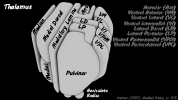
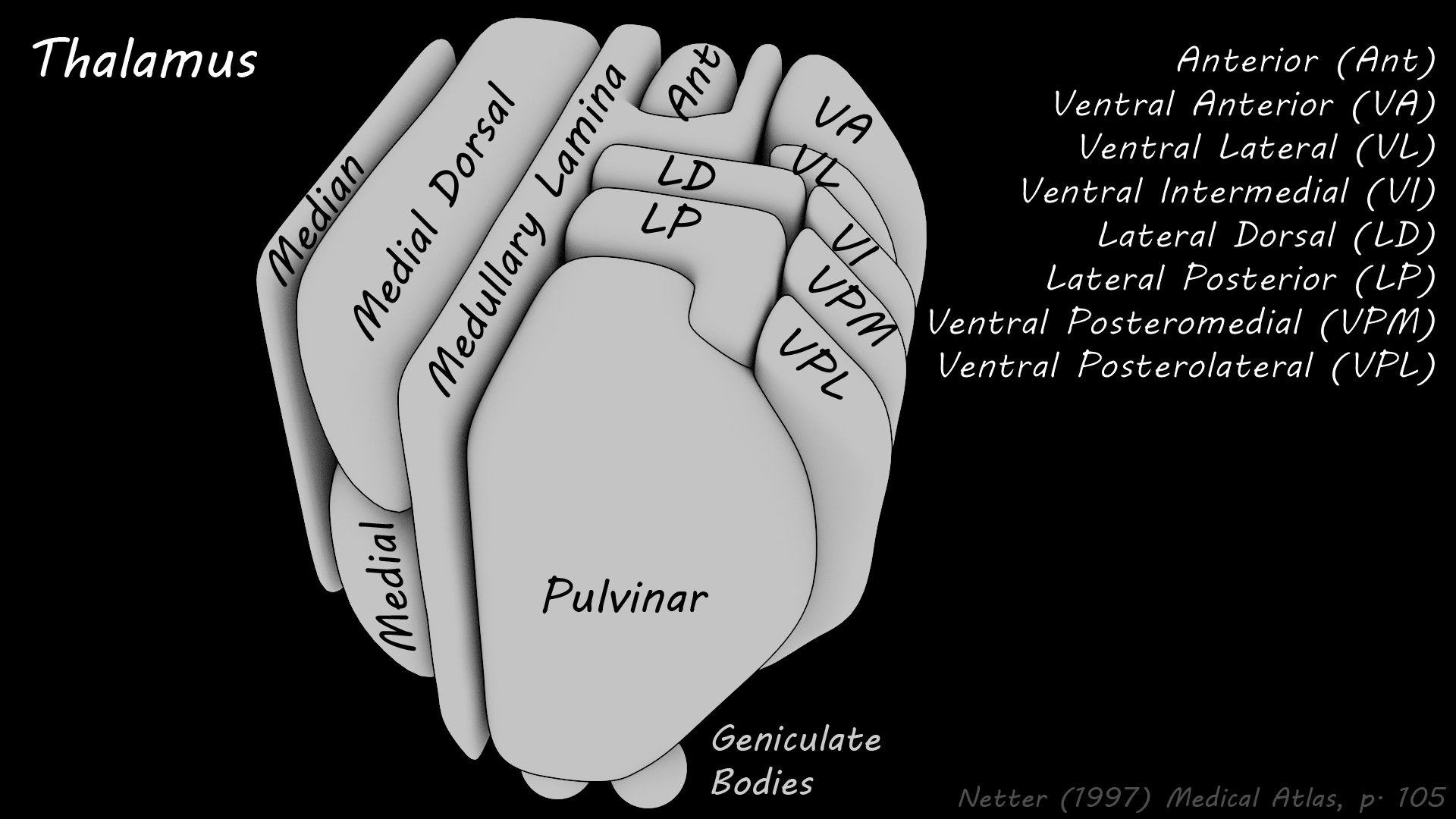
- Thalamus functionality is divided among its 9 thalamic nucleii
III. Anatomy
-
General
- Paired sensory relays
- Located in the posterior Diencephalon of the brain
- Thalamus located on each side of Third Ventricle
- Nucleii
- Ventral Posterolateral Nucleus (VPL)
- Ventral Posteromedial Nucleus (VPM)
- Anterior Thalamic Nucleus
- Portion of the Papez Circuit
- Ventral Lateral Nucleus (VL)
- Cerebellum input
- Vascular supply is from vertebrobasilar circulation
- Posterior Cerebral Artery (PCA)
- Paramedian artery
- Arises from P1 segment and supplies medial Thalamus
- In some patients, paramedian artery supplies bilateral medial Thalamus (see Artery of Pancheron Stroke below)
- Posterior Choroidal artery
- Arises from P2 segment and supplies posterior Thalamus
- Thalamogeniculate artery
- Arises from the P2 segment and supplies lateral Thalamus
- Paramedian artery
- Posterior Communicating Artery (PCoA, arises from the PCA)
- Tuberothalamic artery
- Supplies the anterior Thalamus
- Tuberothalamic artery
- Posterior Cerebral Artery (PCA)
- Images
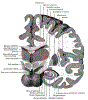 Lewis (1918) Gray's Anatomy 20th ed (in public domain at Yahoo or BartleBy)
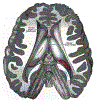 Lewis (1918) Gray's Anatomy 20th ed (in public domain at Yahoo or BartleBy)
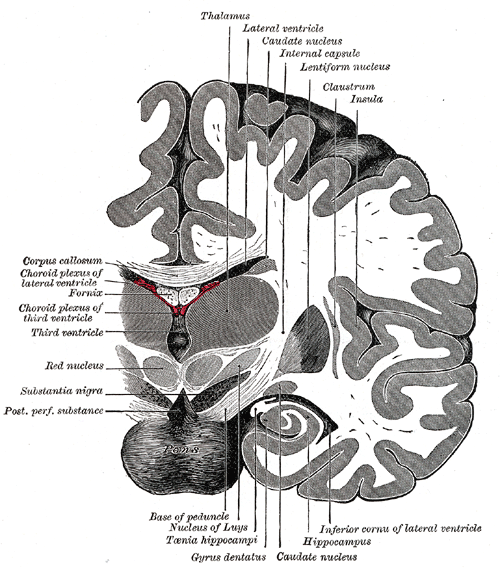
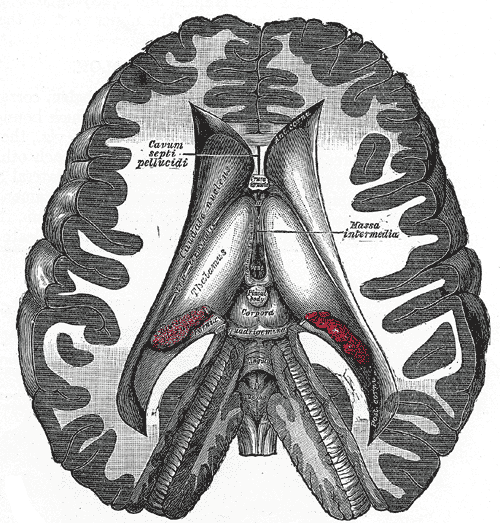
IV. Physiology
- Thalamus acts as a relay and integrative center for sensory input
- Receives peripheral sensory signals through the Brainstem
- Communicates with the Cerebellum, Basal Ganglia and Hypothalamus
- Transmits sensory signals to the cerebral cortex
- Motor signsal from the cerebral cortex bypass the Thalamus via the Internal Capsule
V. Signs: Thalamic Lesion Syndromes
- See Posterior Cerebral Artery CVA
- Contralateral sensory loss
- Pure sensory loss of all modalities may occur
- May cause intense pain refractory to Analgesics
- Visual Findings
- Vertical Gaze Paresis
- Quadrantanopsia
- Visual Hallucinations
- Impaired pursuit (on finger following)
- Motor findings are uncommon in thalamic CVA
- Hyperreflexia
- Positive Babinski Reflex
- Extremity movement may be affected
- Cognitive, Language and Behavior findings
- Decreased Level of Consciousness
- Confabulation
- Perseveration
- Amnesia
- Wandering thoughts
- Aphasia
- Artery of Pancheron Stroke (0.7% of all Ischemic Strokes, 18% of thalamic strokes)
- Single paramedian artery may supply bilateral medial Thalamus (vascular anomaly)
- May result in bilateral thalamic stroke
- Altered Mental Status
- Vertical Gaze Palsy
- Impaired memory
VI. References
- Netter (1997) Atlas Human Anatomy, ICON Learning, p. 105
- Swaminathan and Marcolini (2026) Thalamic Stroke, EM:Rap, 4/20/2026
- Newton (1994) Am Fam Physician 49(4): 787-97 [PubMed]