
II. Definitions
- Dizziness
- Non-motion Sensation of impaired spatial orientation
III. Epidemiology
- Dizziness accounts for 2.5% of emergency department visits
IV. History: Types by Characteristic
-
Vertigo
- Do you feel as if the room is spinning, or that you are on an amusement park ride?
-
Presyncope
- Do you feel suddenly light headed as you may fall to the ground, as if you arose too fast?
-
Vasovagal Syncope?
- Is it brought on with prolonged standing, sitting, heat or stress and associated with sweats and Nausea?
-
Dysequilibrium
- Do you have difficulty maintaining your balance when standing or walking?
-
Muscle Weakness
- Do you feel generally Fatigued or tired?
- Lightheadedness
- Sensation of Faintness or reeling when not characterized by Vertigo, Presyncope, Dysequilibrium
- Images
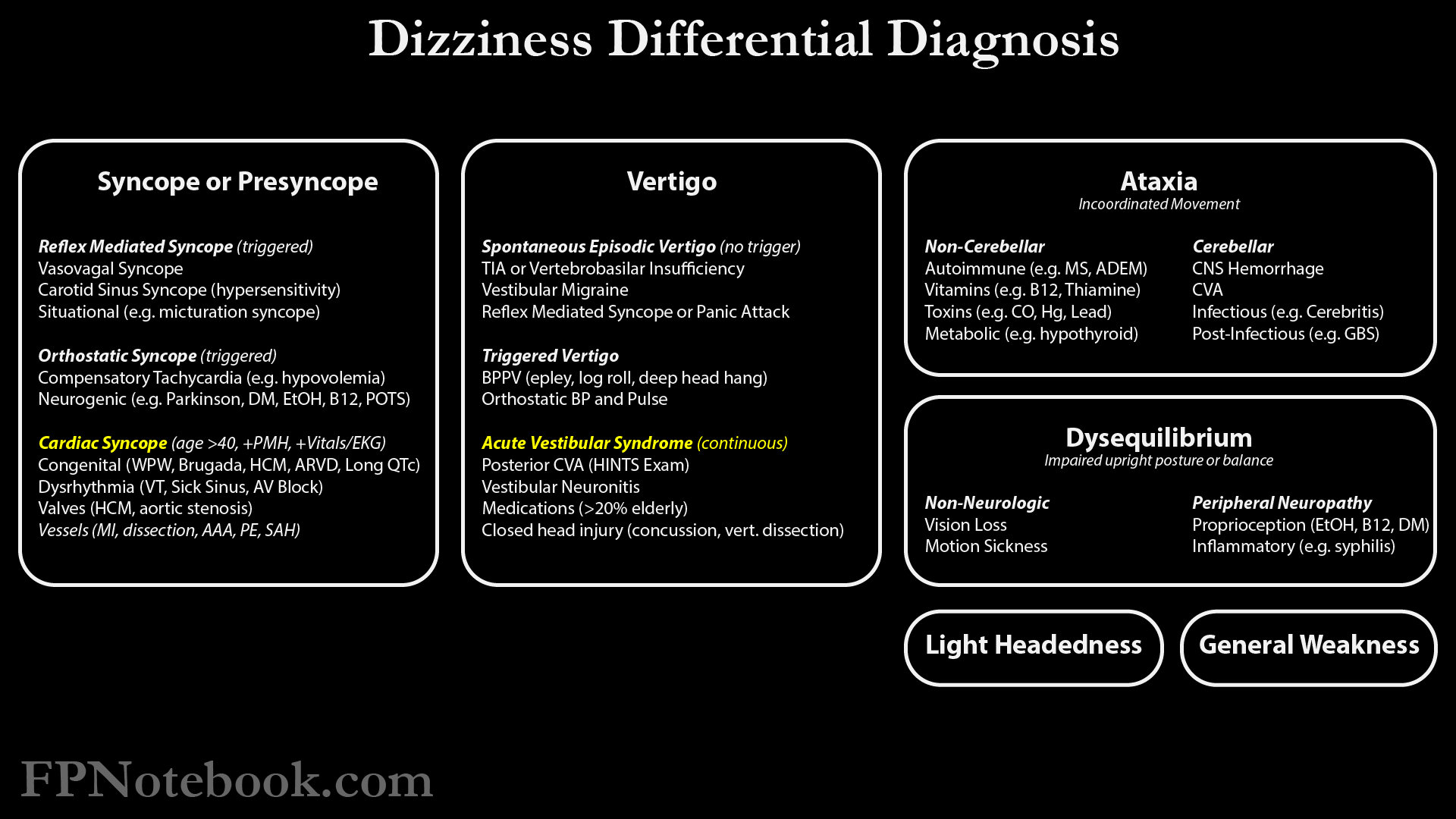
V. Precautions: Critical measures
- Prevent complications related to Dizziness
- See Fall Prevention in the Elderly
- Falls and other accidents
- Identify serious causes of Dizziness
- Presyncope (14% of Dizziness presentations)
- Cerebrovascular Accident
- CNS Lesions (especially posterior CVA) account for 3% of Dizziness presentations
- Dizziness is a presenting symptom in up to 25% of Cerebrovascular Accidents
- Factors more suggestive of Central DIzziness cause
- Atrial Fibrillation
- Vague non-whirling Dizziness Sensation
- Advanced age
- Age 50-70: 3.5% central cause
- Age 70-80: 7.4% central cause of Dizziness
- Age 80-90: 16.7% central cause of Dizziness
- References
VI. Types: Dizziness Causes
-
Vertigo (45-54%)
- Definition
- Sense of motion (e.g. spinning) despite being still
- False or distorted Sensation of self-motion in any direction
- Peripheral Vertigo is always episodic
- Continuous Dizziness is due to behavioral phenomenon
- Peripheral Vertigo examples
- Pitfalls: Central Vertigo
- Posterior Circulation (vertebrobasilar) Cerebrovascular Accident
- Non-Vascular Central Causes of Vertigo (e.g. Acoustic Neuroma, Brainstem lesions, MS)
- Associated Conditions
- Definition
-
Dysequilibrium or Ataxia (16%)
- Off-balance or Unsteadiness (Postural)
- Examples
-
Presyncope (14%)
- Sensation of loss of consciousness
- Examples
- Associated Conditions
- Lightheadedness (10%)
- Vague Sensations not fitting in above categories
- Examples
- Hyperventilation (e.g. Panic Disorder)
- Associated Conditions
VII. References
- Ondrejka (2014) Crit Dec Emerg Med 28(10): 11-7
- Post (2010) Am Fam Physician 82(4): 361-8 [PubMed]
- Kroenke (1992) Ann Intern Med 117:898-904 [PubMed]
- Bisdorff (2009) J Vestib Res 19(1-2):1-13 [PubMed]