
II. Indications: Local Anesthetic
- Infiltration Anesthesia (skin procedures)
- Regional Anesthesia or Nerve Block (e.g. Digital Block)
- Topical Anesthetic (e.g. tetracaine for ocular procedures)
- Spinal Anesthesia
- Epidural Anesthesia
III. Mechanism
- Cocaine was the first Local Anesthetic, with subsequent synthetic agents with similar activity
- Local Anesthetics Inhibit Nerve Conduction
- Decrease the Neuron's membrane permeability to Sodium
- Without Sodium influx when Neurons are activated (depolarization), Action Potentials cannot be generated
- Small nerve fibers are most susceptible to penetration and blockade
- Pain and Temperature sense (A-Delta and C Nerve Fibers) are most susceptible to Local Anesthetic
- Touch and proprioception are less susceptible
- Skeletal Muscle innervating Neurons are least susceptible to Local Anesthetic
- Images
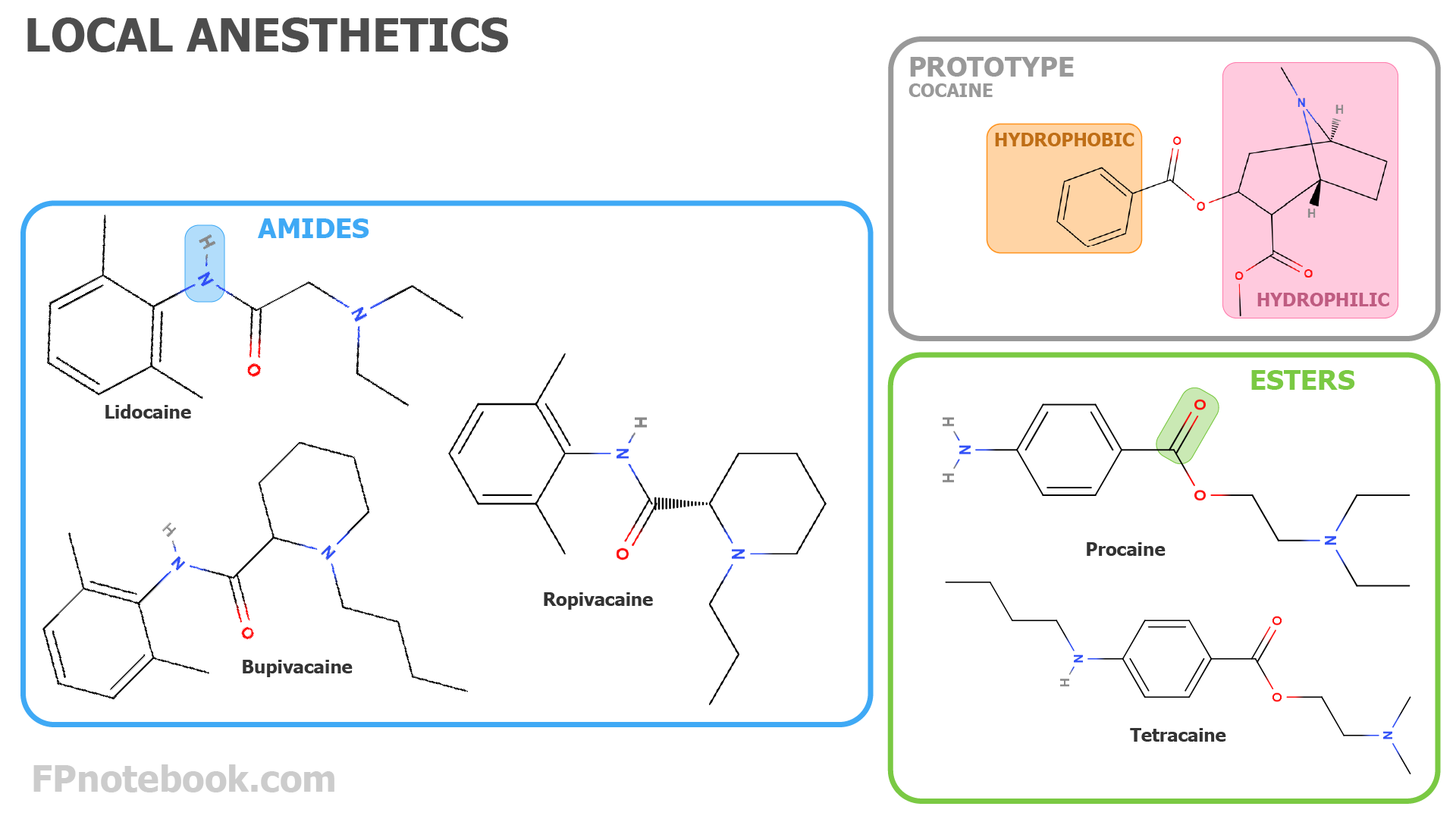
- All synthetic Local Anesthetics have a common structure
- Hydrophobic region (aromatic ring structure)
- Linker region (alkyl chain containing either an amide or ester bond)
- Hydrophilic region (substituted amines)
- Synthetic Local Anesthetics are of 2 classes (differentiated by their linker alkyl chain bond)
- Amides (e.g. Lidocaine)
- Less susceptible to enzymatic degradation, clearing more slowly than esters, with longer duration of activity
- Esters (e.g. Procaine)
- Easily hydrolyzed by plasma esterases, resulting in more rapid breakdown, and shorter duration of activity
- Amides (e.g. Lidocaine)
- Adjunctive Agents
- Bicarbonate
- Added to Local Anesthetic to increase the percentage of non-ionized Anesthetic
- Nonionized Anesthetic reduces the burning Sensation on injection
- Nonionized Anesthetic more easily penetrates the nerve sheath, increasing its Anesthetic activity
- Within the Neuron, the Anesthetic re-ionizes to its active form
- Epinephrine
- Epinephrine induces local Vasoconstriction and Hemostasis, keeping Local Anesthetic within the injected region
- Epinephrine is added to Local Anesthetic to prolong Anesthetic activity
- Epinephrine also reduces systemic absorption (LAST Reaction risk) when added to Local Anesthetic
- Maximum safe Anesthetic total dosages are higher when Epinephrine is added
- Bicarbonate
IV. Technique: Helpful hints to make Local Anesthetic more comfortable
- Use smaller gauge needles (higher numbers)
- Elective procedures: 27 to 30 gauge needle
- Avoid using anything larger than a 25 gauge needle
- Prepare the injection solution
- Warm Lidocaine (Xylocaine) to Body Temperature
- Use Buffered Lidocaine
- Bicarbonate 1 part to Xylocaine 9 part ratio
- Stable at room temp for one week
- Prepare the site
- Cool skin before injection
- Ice
- Quick spray of Liquid Nitrogen, ethyl chloride or frigiderm
- Avoid ethyl chloride when using electrocautery
- Consider Topical Anesthetic use before injection
- See topical pre-Anesthetics below
- Cool skin before injection
- Employ a less painful injection technique
- Rapidly insert needle (do not allow to needle to linger on surface)
- Infiltrate skin slowly and steadily while withdrawing
- Inject through wound edge if possible
- Inject into subcutaneous tissue (equivalent efficacy to injecting into skin, and less painful)
- Be generous with Local Anesthetic
- However, may distort wound edges
- Employ distraction techniques
- Patient lifts their own leg (Gate theory of pain)
- Vibrate skin or pinch skin as you inject
- Have patient keep eyes open (analgous to Lamaze birth)
- Talk calmly to patient
- Mixing Anesthetics offers no benefit
- Lidocaine (1 hour duration) and Bupivicaine (2-4 duration) have very similar onset of action (3 minutes)
- Select one agent for Local Anesthetic based on desired duration of Anesthesia
- Ribotsky (1996) J Am Podiatr Med Assoc 86(10): 487-91 [PubMed]
- Alhelail (2009) Emerg Med J 26(5): 347-50 [PubMed]
V. Pharmacokinetics
- Amide and Ester Anesthetic metabolism and excretion
- Metabolized by liver
- Excreted by Kidney
- Dose calculations
- Solution of 0.5%: 5 mg/ml
- Solution of 1%: 10 mg/ml
- Solution of 2%: 20 mg/ml
VI. Preparations: Topical pre-Anesthetics
- Ethyl Chloride Spray
- Do not use with electrocautery
- Site sprayed for 1-2 seconds
- Offers 1-2 seconds of Anesthesia
-
Lidocaine-Epinephrine-Tetracaine (LET)
- Replaces Tetracaine, Adrenaline, Cocaine (TAC)
- Indicated for open wound
- May be especially useful in children
-
EMLA cream (Eutactic Mixture of Local Anesthetic - Lidocaine 2.5%, Prilocaine 2.5%)
- Indicated in closed wounds
- Apply ointment under Occlusion
- EMLA creamAnesthesia reaches a depth of 3 mm at 1 hour, and 5 mm at 1.5 to 2 hours
- Use 90 minutes prior to injection
- ELA-Max (OTC) may offer similar effect (see below)
-
Iontophoresis
- Lidocaine sponges applied to intact skin
- DC current applied to electrodes over Anesthetic
- Onset within 10 minutes and duration of 15 minutes
- Penetration depth of 1-2 cm
- As effective as EMLA cream
-
Lidocaine 4% in liposomal matrix (LMX or ELA-Max)
- Apply to skin and occlude for 30 minutes (much faster onset than EMLA cream)
- J-Tip (transdermal Lidocaine device)
- Creates eraser sized wheel of Lidocaine that has been shot through the skin without needle
- Onset of Anesthesia within 3 minutes of use
- May also be used for Lumbar Puncture
- Buzzy Bee Vibrating Device (effective in ages 3-18 years; not effective in infants)
- Wings of device are stored in the freezer (use within 10 minutes of removing from freezer)
- Device and wings are placed on skin 5 cm proximal to venipuncture site (or Immunization site)
- Cold and vibration prevents pain fibers from transmitting painful stimuli (gate theory)
- Apply to skin for 1 minute before procedure
- Other measures with unknown efficacy in procedures
VII. Preparations: Local Anesthetics - Short acting Amide Anesthetics
-
Local Lidocaine or Xylocaine (0.5%=5 mg/ml, 1%=10 mg/ml, 2%=20 mg/ml)
- Onset: 2 to 5 minutes
- Duration: 1 hour (up to 1.5 to 3 hours in some cases)
- Max dose: 4 mg/kg to 300 mg/dose (up to 15 ml 2%, 30 ml 1% or 60 ml 0.5%)
- Epinephrine increases Lidocaine duration or activity and maximal safe dose to 7 mg/kg (see below)
- Mepivacaine (Carbocaine) 1%
- Onset: 3 to 5 minutes
- Duration: 1.5 to 2 hours
- Max dose: 4 mg/kg up to 280 mg/dose (28 ml))
- Prilocaine (Citanest) 1%
- Onset: 2 minutes
- Duration: 1 hour
- Max dose: 7 mg/kg up to 500 mg/dose (50 ml)
VIII. Preparations: Local Anesthetics - Long acting Amide Anesthetics
-
Lidocaine with Epinephrine 1:100,000 or 1:200,000
- Onset: 2 minutes
- Duration: 2 to 6 hours
- Max dose: 7 mg/kg to 500 mg (up to 25 ml 2%, 50 ml 1%)
- Epinephrine increases Lidocaine's duration of action and maximal safe dose (decreases systemic absorption)
- Bupivacaine or Marcaine or Sensorcaine (0.25%=2.5 mg/ml, or 0.5%=5 mg/ml)
- Onset: 5 minutes (up to 15-30 minutes)
- Duration: 2 to 4 hours (up to 6 hours, esp. when combined with Epinephrine)
- Max bolus dose: 2 mg/kg (some guidelines use maximum of 2.5 mg/kg)
- Weight >=75 kg (165 lb): 60 ml of 0.25% (2.5 mg/ml) or 30 ml of 0.5% (5 mg/ml)
- Avoid in pregnancy (increased Bioavailability, crosses placenta)
- Always confirm not intravascular (withdraw first) as risk of lethal Arrhythmias (Ventricular Fibrillation)
- See LAST Reaction
- Less risk of systemic absorption when combined with Epinephrine
- Etidocaine (Duranest) 0.5% or 1%
- Max dose: 4 mg/kg to 280 mg/dose (25 ml 1%, 50 ml 0.5%)
- Ropivacaine 0.2 to 0.5%
- Preferred agent in Regional Anesthesia (decreased LAST toxicity risk)
- Decrease dose in liver disease, malnourishment, Critical Illness
- Single bolus
- Onset: 10-20 minutes
- Duration: 6 to 14 hours
- Maximum Dose: 3 mg/kg of 0.5 % (5 mg/ml)
- Weight 50 kg (110 lb): Maximum 30 ml of 0.5% (1 bottle of Ropivacaine)
- Weight 60 kg (132 lb): Maximum 36 ml of 0.5%
- Weight 70 kg (154 lb): Maximum 42 ml of 0.5%
- Weight 80 kg (176 lb): Maximum 45-48 ml of 0.5%
- Weight 90 kg (198 lb): Maximum 45-54 ml of 0.5%
- Weight >=100 kg (220 lb): Maximum 45-60 ml of 0.5% (up to 2 bottles of Ropivacaine)
- Continuous infusion
- Maximum: 0.5 mg/kg/h of 0.2% (2 mg/ml)
- Weight 40 kg: Maximum 10 ml/h of 0.2% (2 mg/ml)
- Weight 50 kg: Maximum 12 ml/h of 0.2% (2 mg/ml)
- Weight >=56 kg: Maximum 14 ml/h of 0.2% (2 mg/ml)
- Maximum: 0.5 mg/kg/h of 0.2% (2 mg/ml)
- References
- Reardon and Martel (2020) Regional Anesthesia for Acute Care Conference, attended 12/11/2020
IX. Preparations: Local Anesthetics - Esters
- Background: Mnemonic to distinguish the Ester Anesthetics from the Amide Anesthetics
- Amides have two "i"
- Esters have one "i"
- Chloroprocaine (Nesacaine)
- Procaine (Novocain) 1%, 2%
- Onset: 2-5 minutes
- Duration: 15 to 60 minutes
- Max Dose: 7 mg/kg up to 600 mg/dose (30 ml 2%, 60 ml 1%)
- Tetracaine (Pontocaine) 0.5%
- Onset: 5-10 minutes
- Duration: 2-3 hours
- Max Dose: 1.4 mg/kg up to 120 mg/dose (24 ml 0.5%)
X. Adverse Effects: LAST Reaction
- See Local Anesthetic Systemic Toxicity (LAST Reaction)
- Prevention
- Exercise caution to avoid intravascular injection of Local Anesthetic
- Limit total Anesthetic dose to weight-based maximums established for each agent
XI. Adverse Effects: Allergy to Local Anesthesia
- True amide Anesthetic is rare
- Usually a reaction to preservative methylparaben
- Novocaine allergy does not predict Lidocaine allergy
- Options if history of Lidocaine allergy
- Preservative-free Lidocaine (single use bottles)
- Select an ester Anesthetic (e.g. Nesacaine, Procaine, Tetracaine)
- Diphenhydramine Hydrochloride 1%
- Dilute 50 mg (1 ml) in 4 ml Normal Saline
- Equivalent to Lidocaine 1% activity
- Avoid use in Peripheral Nerve Block
XII. Resources
- Local Anesthetics: Clinical Pharmacology and Rational Selection
XIII. References
- Acker, Koval and Leeper (2017) Crit Dec Emerg Med 31(4): 3-13
- Pfenninger (1994) Procedures, Mosby, p. 135-155
- Mortiere (1996) Wound Management, p. 27-39
- Achar (2002) Am Fam Physician 66(1):91-4 [PubMed]
- Latham (2014) Am Fam Physician 89(12): 956-62 [PubMed]