
II. Epidemiology
III. Etiology
- Acute: Candida albicans (90%)
- Normal commensal organism in vagina
- Infection when Corynebacterium suppressed
- Recurrent Vulvovaginal Candidiasis (4 or more episodes in a year)
- Candida glabrata (increasing Incidence, now 15%)
- Candida tropicalis
- Candida parapsilosis
- Candida krusei (responds to Topical Antifungals, but not to Fluconazole)
- Saccharomyces cerevisiae
IV. Risk Factors
-
Immunosuppression
- Diabetes Mellitus (esp. Uncontrolled)
- Depressed cell mediated Immunity (e.g. HIV or AIDS)
- Medications
- Corticosteroids
- Immunosuppressant Medications
- Broad spectrum antibiotics
- Oral Contraceptives
- Increases frequency of Candida carrier state
- Does not increase symptomatic Vulvovaginitis
- Heat and moisture retaining clothing (e.g. nylon)
- Pregnancy (and other hyperestrogenic states)
- Premenstrual phase of the Menstrual Cycle
- Obesity
V. Symptoms
- Asymptomatic in 20-50% of women
- Intense vaginal or Vulvar Pruritus (50% of cases)
- Vulvar Burning, soreness, or irritation
- Thick white curd-like or "cottage cheese" discharge
- No odor
- Dyspareunia
- Dysuria (33% of cases)
VI. Signs
- Adherent white cottage-cheese discharge in vagina
- Sensitivity: 50%
- Specificity: 90%
- Vulvar erythema and edema (24% of cases)
VII. Labs: Initial
-
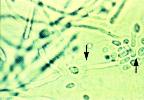
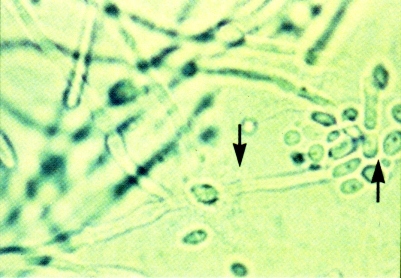
KOH Preparation (10%)
- Test Sensitivity: 50%
- Pseudohyphae or budding yeast forms
- Vaginal pH <4.5 (Normal acidity)
- Absent Amine odor
- White Blood Cells not increased
- Wet-Prep is not sensitive or specific for yeast
- Candida on Pap Smear
- Specific but very low Test Sensitivity
VIII. Labs: Complicated cases
- Indications: Complicated Vulvovaginal Candidiasis
- Recurrent candida Vaginitis (4 or more episodes in a year) OR
- Severe candida infections OR
- Immunocompromised patients (AIDS, poorly controlled Diabetes Mellitus)
-
Fungal Culture positive
- Fungal Culture is rarely performed in typical cases (fungal PCR preferred)
- Fungal Culture may be helpful in complicated cases
- Confirm asymptomatic carrier of vaginal Candida
- Identify cause of recurrent Vaginitis (e.g. Candida Glabrata)
- DNA probe or PCR for candida
- Consider in cases refractory to standard therapy
IX. Differential Diagnosis (Consider for refractory cases)
- Other Vaginitis cause
- Infectious Cervicitis (Sexually Transmitted Infection)
- Allergic Vaginitis or Vulvitis
- Vulvodynia
-
Herpes Simplex Virus
- HSV presents with unilateral painful lesions
- Contrast with bilateral, symmetric involvement in Candida Vulvovaginitis
X. Management: OTC Local First-Line Agents
- Precautions
- In pregnancy, limit to topical azole preparations (Miconazole, Clotrimazole) used for 7 days (lower concentrations)
-
Miconazole (Monistat)
- Miconazole (Monistat-7) 2% cream PV qhs for 7 days
- Miconazole (Monistat-3) 4% cream, 5 g PV qhs for 3 days
- Miconazole Vag tabs 100mg PV qhs for 7 days
- Miconazole (Monistat-3) 200mg PV qhs for 3 days
- Miconazole 1200 mg vaginal tab PV qhs, 1 dose
-
Clotrimazole (Gyn-Lotrimin, Mycelex G)
- Clotrimazole 1% cream qhs for 7 days
- Clotrimazole 2% cream qhs for 3 days
- Clotrimazole 200 mg vaginal tab PV qhs for 3 days
- Clotrimazole 100 mg vaginal tab PV qhs for 7 days
- Clotrimazole 500 mg vaginal tab PV qhs, 1 dose
- Terconazole (Newer, binds better to Candida)
- Vagistat-1 6.5% ointment, 5 g intravaginally once
- Highly effective and less irritating than creams
- Vagistat-1 6.5% ointment, 5 g intravaginally once
XI. Management: Prescription Local First-Line Agents
- Butoconazole (Femstat)
- Mycelex-3 5g of 2% Cream PV QHS for 3 days
- Gynezole-1 (sustained release, bioadhesive) 5 g of 2% cream once intravaginally
- Terconazole (Newer, binds better to Candida)
- Terazol 80 mg vaginal suppository PV for 3 days
- Terazol-3 (0.8%) 5 g vaginal cream for 3 days
- Terazol-7 (0.4%) 5 g vaginal cream qhs for 7 days
- Nystatin
XII. Management: Oral Agents
-
Fluconazole 150 mg PO for 1 dose
- As effective as Clotrimazole PV
- Do not use in pregnancy
- Evidence of Miscarriage risk, with even 1-2 doses
- Mølgaard-Nielsen (2016) JAMA 315(1):58-67 +PMID:26746458 [PubMed]
- Consider repeat scheduled treatment for persistent symptoms
- Consider prescribing Fluconazole 150 mg every 3 days for up to 3 doses for persistent Vaginitis symptoms
- Symptom improvement delayed for 24 hours with Fluconazole
- Consider concurrently treating with Nystatin ointment (100,000 units) for the first several days (least irritating)
- Higher mycologic cure rates in the short term (NNT 30) and long term (NNT 19) compared with intravaginal agents
- References
- Brexafemme (Ibrexafungerp)
- Dosing: 150 mg tablet with two tablets (300 mg) taken in 2 doses at 12 hours apart (total course: 600 mg)
- Reduce dose to 150 mg every 12 hours for 2 doses if taking strong CYP3A4 inhibitors (e.g. Ketoconazole, Clarithromycin)
- Consider in recurrent candida Yeast Vaginitis refractory to repeat Fluconazole dosing
- Cost is nearly 50 fold higher than generic Fluconazole (approxmately $500 for 2 doses)
- Marketed as fungicidal against yeast (in contrast to fungistatic azoles such as Fluconazole, Clotrimazole)
- However, in practice, first-line azoles are 80-90% effective for definitive resolution
- Contraindicated in pregnancy
- Use reliable Contraception during treatment and for 4 days after last dose
- Adverse effects include Nausea, Abdominal Pain and Diarrhea
- References
- (2021) Presc Lett 28(9): 49-50
- Woolfolk (2022) Am Fam Physician 106(3): 324-6 [PubMed]
- Dosing: 150 mg tablet with two tablets (300 mg) taken in 2 doses at 12 hours apart (total course: 600 mg)
XIII. Management: Recurrent or resistant Treatment
- Precautions
- Avoid treating asymptomatic carriers (may be normal flora in some patients)
- Consider risk factors above
- Consider Fungal Culture and exam timing before and after treatment
- Baseline
- Two weeks (after treatment regimen above)
- Three months
- Six months (when stopping prophylaxis)
- Any of above intravaginal meds (e.g. Clotrimazole) for 14-21 days
- Consider maintenance after initial daily regimen (see below)
- Consider Terconazole (see above)
- More effective against other candida species
-
Fluconazole (Diflucan)
- Less effective for non-albicans Candida (e.g. Candida Glabrata)
- Dose 1: 150 mg orally
- Dose 2: 150 mg PO at 72 hours after first dose
- Consider a 3rd dose at 72 hours after second
- Consider, repeat dosing once weekly for up to 6 months (See below for maintenance protocol)
- Sobel (2001) Am J Obstet Gynecol 185:363-9 [PubMed]
- Other options (many with increased toxicity and risk)
- Itraconazole (Sporanox) 200 mg PO qd for 3 days
- Gentian Violet vaginal staining 1-2x (Office charge)
- Boric Acid 600 mg vaginal tab bid for 14 days
- Use is controversial, but may be considered in refractory non-albicans candidal infection (e.g. Candida Glabrata)
- Sobel (2003) Am J Obstet Gynecol 189(5): 1297-1300 [PubMed]
- Flucytosine (Ancobon) cream applied to affected area
- Ketoconazole (Nizoral) 200 mg orally twice daily for 5-14 days
- Avoid oral Ketoconazole due to hepatotoxicity
XIV. Management: Prophylaxis or Maintenance Protocol
- Indication
- Three to Four or more Vaginal Yeast Infections per year
-
Topical Antifungal Protocol
- Repeat application once or twice weekly for 6 months
- Consider using monthly at time of Menses
- Clotrimazole 500 mg vaginal tab weekly to montly
- Miconazole 100 mg vaginal tab qhs twice weekly
-
Fluconazole Protocol
- Initial treatment: Fluconazole (Diflucan) 150 mg orally every 3 days for 3 doses
- Maintenance
- Fluconazole (Diflucan) 150 mg orally each week
- Monitor liver enzymes (consider every 1-2 months)
- Efficacy
- Suppression while on treatment: 90%
- Following treatment: Infection recurs in 60%
- References
- Oteseconazole (Vivjoa)
- No evidence of benefit over other less expensive, less risky Antifungal options above
- Expensive ($2700 per course)
- Teratogenic for up to 2 years after use in animal studies
- Do NOT Use in any woman of child bearing potential
- Limit to post-menopausal women or who are permanently infertile
- References
- (2022) Presc Lett 29(9): 53
XV. Prevention
- Control predisposing condition (e.g. Diabetes Mellitus)
- Reduce predisposing medications (e.g. Corticosteroid)
- Avoid moisture-retaining products near vagina
- Nylon underwear
- Panty-liners
- Vaginal Lubricants or Spermicides
- Lactobacillus (Probiotic) is not effective
- Does not prevent post-antibiotic Vaginitis
- Pirotta (2004) BMJ 329:548-51 [PubMed]
XVI. References
- Desai (1996) Am Fam Physician 54(4):1337-40 [PubMed]
- Hainer (2011) Am Fam Physician 83(7): 807-15 [PubMed]
- Nyirjesy (2001) Am Fam Physician 63(4):697-702 [PubMed]
- Paladine (2018) Am Fam Physician 97(5): 321-9 [PubMed]
- Sobel (1998) Am J Obstet Gynecol 178:203-11 [PubMed]
- Tobin (1995) Am Fam Physician 51(7):1715-20 [PubMed]